
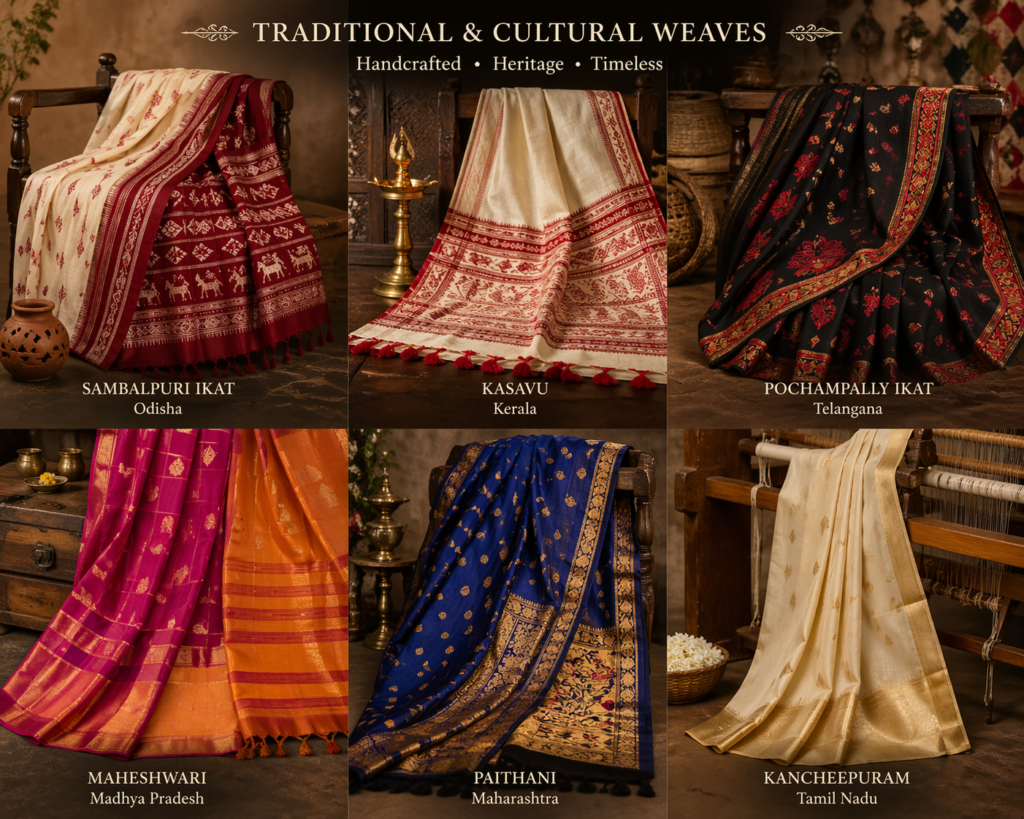
The story of an Indian handloom saree is not merely a history of textiles; it is the biography of a civilization. For over five millennia, the rhythmic click-clack of the loom has been the heartbeat of Indian villages, weaving together the diverse threads of culture, spirituality, and commerce.
Whether it is a heavy silk masterpiece or a simple cotton weave, the handloom saree remains a symbol of India’s enduring heritage and the soul of its rural economy.
Would you like me to incorporate this focus keyword into a specific section of the text, such as the regional masterpieces table?
To understand where it all began, we must travel back to the dusty excavations of the Indus Valley and follow the golden thread through the courts of Mughal emperors, the struggles of the Swadeshi movement, and into the modern global fashion landscape.
Table of Contents
The Genesis: Fibers of Antiquity
The origins of Indian weaving are literally woven into the fabric of human history. Archeological evidence from Mohenjo-daro (circa 3000 BCE) unearthed fragments of woven cotton dyed with madder, suggesting that the inhabitants of the Indus Valley Civilization were not only proficient in spinning and weaving but were also masters of the complex art of mordant dyeing.
Ancient Vedic literature further cements this legacy. The Rig Veda contains metaphors comparing the transition from day to night to a weaver stretching thread over a loom. In these early eras, weaving was more than a trade—it was a sacred act. Each region began to experiment with the raw materials available to them:
- Cotton in the fertile plains of the Ganges and the Indus.
- Silk along the foothills of the Himalayas and the southern plateaus.
- Wool in the rugged terrain of the North.
By the time the Mauryan Empire rose to power (322–185 BCE), textile production was already a sophisticated, state-regulated industry. Kautilya’s Arthashastra mentions specialized artisans and the high quality of cotton fabrics produced in Kashi (Varanasi) and Madurai.
The Golden Era: Patronage and Perfection
As India moved into the medieval period, the handloom industry reached a level of artistic perfection that remains unparalleled. This was the era of the Great Silk Routes and the maritime trade that carried Indian “woven air” to the Roman Empire and beyond.
The Mughal Influence
The arrival of the Mughals in the 16th century brought a seismic shift in aesthetic sensibilities. The emperors were connoisseurs of luxury, and under their patronage, weavers began incorporating Persian motifs—the buta (floral spray), the paisley, and intricate geometry—into Indian weaves.
It was during this time that the Jamdani and Chanderi fabrics reached their zenith. Legend has it that the Dacca Muslin was so fine that a full-length saree could pass through a thumb ring. The Mughals also popularized the use of Zari (thread made of real gold or silver), turning garments into literal pieces of jewelry.
Regional Masterpieces
While the North focused on floral delicacy, the South developed a language of architectural grandeur. The temples of Tamil Nadu and Andhra Pradesh became the primary patrons of the weaving communities.
- Kanjeevaram: Inspired by temple carvings, these heavy silks used contrasting borders and “temple” patterns.
- Paithani: In Maharashtra, the Maratha royalty patronized these silks characterized by their oblique square borders and peacock motifs.
The Dark Threads: Colonialism and the Industrial Blow
The 18th and 19th centuries marked the most challenging chapter in the tale of Indian handlooms. With the advent of the British East India Company, the focus shifted from trade to exploitation.
The British Industrial Revolution introduced power-loom-produced textiles from Manchester and Lancashire. These mass-produced fabrics were flooded into the Indian market with zero import duties, while heavy taxes were levied on Indian hand-woven exports. This systemic dismantling of the local industry led to the impoverishment of millions of weavers. The “woven air” was replaced by cheap, standardized calico.
The Resurrection: The Loom as a Weapon of War
In the early 20th century, the handloom became a symbol of defiance. Mahatma Gandhi recognized that India’s economic and spiritual independence was tied to its self-reliance. He turned the spinning wheel (the Charkha) and the hand-spun fabric (Khadi) into the ultimate tools of the Swadeshi movement.
By urging Indians to burn foreign cloth and wear only what was hand-woven at home, Gandhi transformed the loom from a tool of survival into a weapon of political revolution. The handloom was no longer just about fashion; it was about dignity, identity, and the reclamation of Indian heritage.
The Diversity of the Indian Loom: A Geographical Journey
To appreciate Indian handlooms today is to recognize that “Indian textile” is not a monolith. Every state offers a unique dialect of weaving.
| Region | Iconic Weave | Distinctive Feature |
| Uttar Pradesh | Banarasi | Heavy gold/silver brocade and fine silk. |
| Odisha | Sambalpuri Ikat | The tie-dyeing of threads before weaving to create blurry patterns. |
| Assam | Muga Silk | A naturally golden silk found only in the Brahmaputra valley. |
| Gujarat | Patola | Double Ikat, where both warp and weft are dyed, requiring immense precision. |
| Madhya Pradesh | Maheshwari | Lightweight cotton-silk blends with reversible borders. |
| West Bengal | Tant | Airy, breathable cotton perfect for the humid climate. |
The Modern Renaissance: Challenges and the Way Forward
Today, the Indian handloom industry is at a crossroads. It remains the second-largest employer in rural India, second only to agriculture. However, it faces stiff competition from modern power looms and the fast-fashion industry.
The Survival of the Craft
The modern consumer’s shift toward Sustainable Fashion has breathed new life into the sector. Handloom is, by definition, eco-friendly. It has a low carbon footprint, requires no electricity, and uses natural fibers. Designers are now collaborating directly with weaver clusters to modernize silhouettes while keeping the ancient techniques intact.
The Digital Thread
Technology, which once threatened the handloom, is now its greatest ally. E-commerce allows a weaver in a remote village in Telangana to sell a Pochampally saree to a buyer in New York or Paris. Programs like the “Handloom Mark” and “Geographical Indication (GI) Tags” help protect these traditional crafts from cheap imitations.
Why Handlooms Matter Today
In a world of mass-produced, disposable clothing, a handloom garment is a masterpiece of “slow fashion.”
- Uniqueness: Because it is handmade, no two pieces are ever identical. The slight irregularities are the signature of the artisan.
- Cultural Literacy: Wearing a handloom saree or dupatta is a way of carrying forward a 5000-year-old story.
- Livelihood: Supporting handlooms ensures that the skill-set of the artisan community is passed down to the next generation, preventing the death of a traditional art form.
Conclusion: The Unending Warp and Weft
The tale of Indian handlooms began in the mud-brick houses of the Indus Valley, but it doesn’t end there. It continues every time a weaver sits at their loom, crossing the warp and the weft to create something beautiful. It is a story of resilience—a craft that survived empires, industrialization, and globalization.
As we look toward a future that values sustainability and authenticity, the Indian handloom stands as a testament to the fact that some things are best done the old way: with patience, with passion, and by hand.
“The loom is the machine, but the weaver is the soul.”
Key Takeaways for the Conscious Consumer:
- Look for the GI Tag: This ensures the product is an authentic craft from a specific region.
- Understand the Labor: A single Banarasi or Patola saree can take anywhere from three weeks to six months to weave.
- Support Small: Buying directly from weaver cooperatives ensures that the profit goes to the artist, not the middleman.
The Biography of a Civilization: The Timeless Legacy of the Indian Handloom Saree
The story of an handloom saree is not merely a history of textiles; it is the biography of a civilization. For over five millennia, the rhythmic click-clack of the loom has been the heartbeat of Indian villages, weaving together the diverse threads of culture, spirituality, and commerce. From the fine muslins of ancient Bengal to the regal Kanjeevaram handloom saree of the South, the Indian handloom sector represents one of the oldest and largest cottage industries in the world.
To wear a handloom saree today is to wrap oneself in a 5,000-year-old legacy. To understand where it all began, we must travel back to the dusty excavations of the Indus Valley and follow the golden thread through the courts of Mughal emperors, the struggles of the Swadeshi movement, and into the modern global fashion landscape.
The Genesis: Fibers of Antiquity
The origins of Indian weaving are literally woven into the fabric of human history. Archaeological evidence from Mohenjo-daro (circa 3000 BCE) unearthed fragments of woven cotton dyed with madder, suggesting that the inhabitants of the Indus Valley Civilization were masters of the complex art of mordant dyeing.
Ancient Vedic literature further cements this legacy. The Rig Veda contains metaphors comparing the transition from day to night to a weaver stretching thread over a loom. In these early eras, weaving a handloom saree was more than a trade—it was a sacred act. Each region began to experiment with the raw materials available to them: cotton in the fertile plains of the Ganges, silk along the Himalayan foothills, and wool in the rugged North. By the time of the Mauryan Empire, the high quality of cotton fabrics produced in Kashi (Varanasi) was already legendary.
The Golden Era: Patronage and Perfection
As India moved into the medieval period, the handloom saree reached a level of artistic perfection that remains unparalleled. This was the era of the Great Silk Routes, where Indian “woven air” was exported to the Roman Empire and beyond.
The Mughal Influence
The arrival of the Mughals in the 16th century brought a seismic shift in aesthetic sensibilities. The emperors were connoisseurs of luxury, and under their patronage, weavers began incorporating Persian motifs—the buta (floral spray), the paisley, and intricate geometry—into the Indian handloom saree.
It was during this time that the Jamdani and Chanderi fabrics reached their zenith. Legend has it that the Dacca Muslin was so fine that a full-length handloom saree could pass through a thumb ring. The Mughals also popularized the use of Zari (thread made of real gold or silver), turning garments into literal pieces of jewelry.
Regional Masterpieces
While the North focused on floral delicacy, the South developed a language of architectural grandeur. The temples of Tamil Nadu and Andhra Pradesh became the primary patrons of the weaving communities, giving birth to the Kanjeevaram handloom saree. Inspired by temple carvings, these heavy silks used contrasting borders and “temple” patterns that remain a staple of Indian bridal wear today.
The Dark Threads: Colonialism and the Industrial Blow
The 18th and 19th centuries marked the most challenging chapter for the handloom saree. With the advent of the British East India Company, the focus shifted from trade to exploitation. The British Industrial Revolution introduced power-loom-produced textiles from Manchester. These mass-produced fabrics were flooded into the Indian market with zero import duties, while heavy taxes were levied on Indian hand-woven exports. This systemic dismantling of the industry led to the impoverishment of millions of weavers. The “woven air” of the traditional handloom saree was replaced by cheap, standardized calico.
The Resurrection: The Loom as a Weapon of War
In the early 20th century, the handloom became a symbol of defiance. Mahatma Gandhi recognized that India’s economic independence was tied to its self-reliance. He turned the spinning wheel (Charkha) and hand-spun fabric (Khadi) into the ultimate tools of the Swadeshi movement. By urging Indians to wear only what was hand-woven at home, Gandhi transformed the handloom saree from a garment into a weapon of political revolution and a badge of dignity.
A Geographical Journey of the Handloom Saree
To appreciate the handloom saree today is to recognize that Indian textile is not a monolith. Every state offers a unique dialect of weaving:
- Banarasi Handloom Saree (Uttar Pradesh): Known for its heavy gold and silver brocade and fine silk, these are the gold standard for Indian weddings.
- Sambalpuri Ikat (Odisha): Created through a complex tie-dyeing of threads before weaving, resulting in beautiful, blurry patterns.
- Muga Silk (Assam): A naturally golden silk found only in the Brahmaputra valley, often used to create a durable and lustrous handloom saree.
- Patola (Gujarat): A double-ikat masterpiece where both warp and weft are dyed. A single Patola handloom saree can take six months to a year to complete.
- Maheshwari (Madhya Pradesh): Lightweight cotton-silk blends featuring reversible borders, originally popularized by Queen Ahilyabai Holkar.
- Tant (West Bengal): Airy, breathable cotton sarees that are perfect for the humid Indian climate.
The Modern Renaissance: Challenges and the Way Forward
Today, the industry is at a crossroads. While it remains the second-largest employer in rural India, the handloom saree faces stiff competition from modern power looms and fast fashion. However, the modern consumer’s shift toward sustainable fashion has breathed new life into the sector.
The Survival of the Craft
A handloom saree is, by definition, eco-friendly. It has a low carbon footprint, requires no electricity, and uses natural fibers. Modern designers are now collaborating directly with weaver clusters to modernize silhouettes while keeping ancient techniques intact.
The Digital Thread
Technology is now an ally. E-commerce allows a weaver in a remote village to sell a Pochampally handloom saree to a buyer in New York or Paris. Programs like the “Handloom Mark” and “Geographical Indication (GI) Tags” help protect these traditional crafts from cheap, machine-made imitations.
Why the Handloom Saree Matters Today
In a world of disposable clothing, a handloom saree is a masterpiece of “slow fashion.”
- Uniqueness: Because it is handmade, no two sarees are identical. The slight irregularities are the signature of the artisan.
- Cultural Literacy: Wearing a handloom saree is a way of carrying forward a 5,000-year-old story.
- Livelihood: Supporting handlooms ensures that the skill-set of the artisan community is passed down, preventing the death of a traditional art form.
Conclusion: The Unending Warp and Weft
Key Takeaways for the Conscious Consumer:
- Look for the GI Tag: This ensures your handloom saree is an authentic craft from a specific region.
- Understand the Labor: A single Banarasi or Patola saree can take anywhere from three weeks to six months to weave.
- Support Small: Buying directly from weaver cooperatives ensures that the profit goes to the artist, not a middleman.