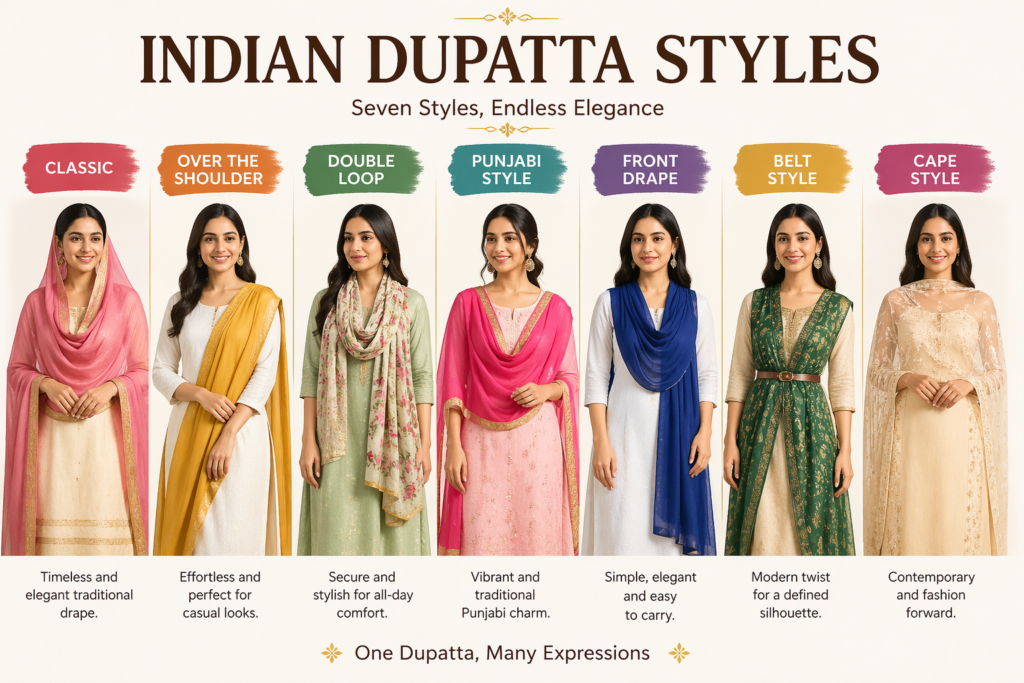
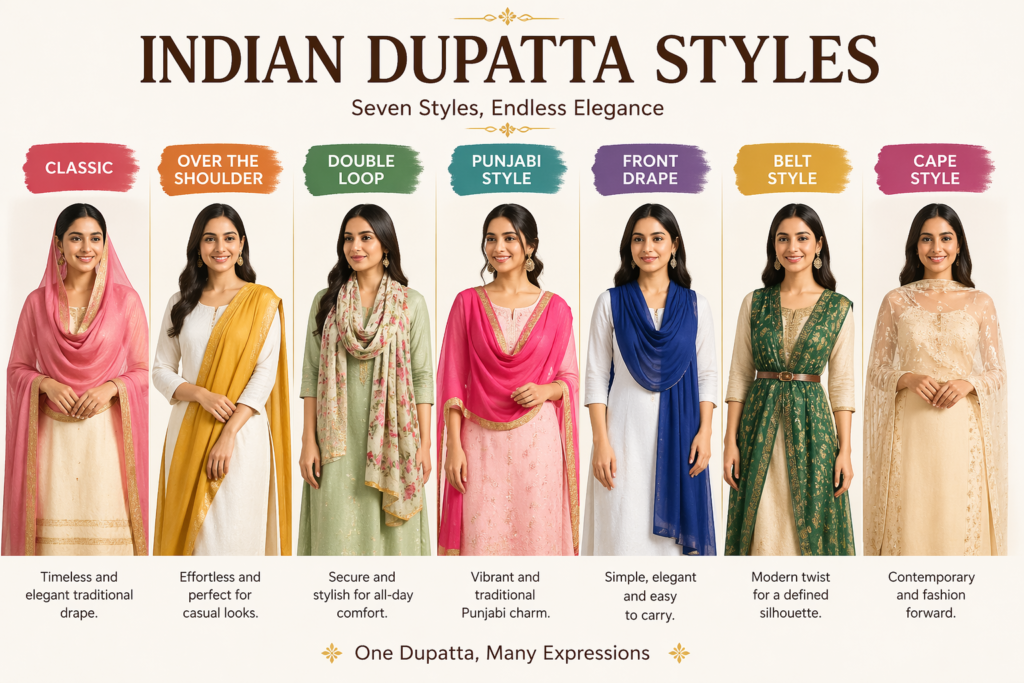
Indian dupatta styles are more than just variations of a rectangular piece of fabric—they are expressions of identity, culture, and personal style. In the vast landscape of South Asian fashion, the dupatta stands as a storyteller, a shield, a crowning glory, and a canvas for self-expression. While its origins are deeply rooted in modesty and tradition, the modern dupatta has evolved into a powerful symbol that reflects personality, mood, and individuality.
Across regions and generations, Indian dupatta styles have taken on diverse forms, each carrying its own cultural significance and aesthetic appeal. From the graceful drape over the head seen in traditional ceremonies to the casually tossed style over one shoulder in contemporary fashion, every way of wearing a dupatta tells a different story. In northern India, heavily embroidered dupattas often symbolize celebration and grandeur, while in southern regions, lighter and more functional styles reflect simplicity and elegance. These variations are not random—they are shaped by climate, customs, and evolving fashion sensibilities.
The beauty of Indian dupatta styles lies in their versatility. A single dupatta can transform an entire outfit, elevating a simple dress into something festive or adding a modern twist to a classic ensemble. For instance, pairing a plain kurta with a vibrant, printed dupatta can instantly create a striking contrast, while a delicately embellished dupatta can add sophistication to even the most minimal attire. This adaptability makes the dupatta one of the most powerful styling tools in ethnic fashion.
Beyond aesthetics, the dupatta carries deep emotional and psychological meaning. The way a person chooses to drape it can reflect confidence, tradition, creativity, or even rebellion. A neatly pinned dupatta may convey discipline and grace, often associated with formal or professional settings. On the other hand, a free-flowing, unpinned style can represent a relaxed, confident personality that embraces comfort and individuality. In this sense, Indian dupatta styles become a silent language—communicating who you are without the need for words.
Historically, the dupatta has been a symbol of respect and modesty, especially in traditional and religious contexts. Covering the head with a dupatta during ceremonies or in places of worship is a practice that continues to hold cultural importance. However, as fashion evolves, so does the meaning of the dupatta. Today, it is no longer confined to tradition alone; it has become a statement piece that blends heritage with modernity. Designers experiment with fabrics, prints, and draping techniques, reimagining the dupatta in ways that appeal to younger generations while still honoring its roots.
Fabrics play a crucial role in defining Indian dupatta styles. From the richness of silk and velvet to the lightness of chiffon and cotton, each material offers a different look and feel. Silk dupattas, often adorned with intricate zari work, are synonymous with luxury and are commonly worn during weddings and festive occasions. Chiffon and georgette dupattas, on the other hand, are favored for their fluidity and ease of draping, making them ideal for both casual and semi-formal wear. Cotton dupattas, with their breathable texture, are perfect for everyday use, especially in warmer climates. The choice of fabric not only affects the overall appearance but also influences how the dupatta moves and interacts with the body.
Color and design further enhance the expressive power of the dupatta. Bright, bold colors like red, yellow, and royal blue often symbolize celebration and joy, while pastel shades convey subtlety and elegance. Traditional prints such as bandhani, block prints, and ikat patterns reflect regional artistry and craftsmanship, connecting the wearer to a rich cultural heritage. At the same time, contemporary designs featuring abstract patterns and digital prints cater to modern tastes, showcasing the evolving nature of Indian dupatta styles.
In recent years, the global fashion industry has embraced the dupatta, incorporating it into fusion wear and international runway collections. This cross-cultural exchange has expanded the scope of Indian dupatta styles, introducing them to a wider audience and inspiring new interpretations. Today, you might see a dupatta styled with western outfits, such as dresses or even jeans, creating a unique blend of traditional and modern aesthetics. This fusion not only highlights the adaptability of the dupatta but also reinforces its relevance in a globalized world.
Social media has also played a significant role in popularizing different draping styles. Influencers and fashion enthusiasts share creative ways to style dupattas, encouraging experimentation and personal expression. Tutorials and styling tips make it easier for people to explore new looks, breaking away from conventional methods and embracing innovation. As a result, Indian dupatta styles are constantly evolving, shaped by both tradition and contemporary trends.
Sustainability is another emerging aspect of modern dupatta fashion. With increasing awareness about environmental impact, many designers are focusing on eco-friendly fabrics and ethical production methods. Handwoven and handcrafted dupattas are gaining popularity, not only for their uniqueness but also for their contribution to supporting local artisans. This shift towards sustainable fashion adds another layer of meaning to the dupatta, making it a symbol of conscious and responsible choices.
Ultimately, Indian dupatta styles represent a harmonious blend of tradition and transformation. They honor the past while embracing the present, offering endless possibilities for self-expression. Whether worn as a mark of cultural pride, a fashion statement, or a personal comfort, the dupatta continues to hold a special place in the world of fashion. Its ability to adapt, evolve, and inspire ensures that it will remain relevant for generations to come.
In conclusion, the dupatta is far more than an accessory—it is a narrative woven into fabric. It reflects history, identity, and creativity, allowing individuals to express themselves in subtle yet powerful ways. As Indian dupatta styles continue to evolve, they remind us that fashion is not just about what we wear, but about how we choose to tell our story.
The way you choose to wear your dupatta—whether you pin it with military precision or let it trail behind you like a royal cape—reveals subtle nuances about your personality, your current mood, and your approach to the world. It is the “finishing touch” that defines the silhouette of an outfit and, by extension, the silhouette of the person wearing it.
Let’s dive deep into the diverse styles of dupatta draping and decode the personalities behind them.
Table of Contents
1.Indian Dupatta Styles: The Classic One-Shoulder Fall – The Balanced Professional
Indian Dupatta Styles: The Classic One-Shoulder Fall – The Balanced Professional
Among the many Indian dupatta styles, this is perhaps the most popular choice for formal and semi-formal settings. In this timeless approach to Indian dupatta styles, the fabric is neatly folded and draped over one shoulder, usually pinned in place, allowing the length to fall gracefully at both the front and back. This method stands out within Indian dupatta styles for its clean, structured, and effortlessly elegant appearance, making it a go-to option for modern women.
When exploring Indian dupatta styles, this particular drape reflects a personality that values balance and efficiency. If this is your preferred choice among Indian dupatta styles, you are someone who appreciates tradition while embracing a modern outlook. You are likely organized and dependable, someone who keeps a structured schedule yet knows how to enjoy moments of spontaneity. This blend of discipline and flexibility is what makes this one of the most versatile Indian dupatta styles.
From a practicality standpoint, this is one of the most functional Indian dupatta styles. It allows you to maintain a polished and professional look without worrying about constant adjustments. Whether you’re attending meetings, events, or social gatherings, this drape ensures the fabric stays in place while giving you complete freedom of movement. Among all Indian dupatta styles, it strikes the perfect balance between style and convenience.
In terms of confidence, this is one of the most expressive Indian dupatta styles. It subtly frames your outfit without overpowering it, allowing your attire and personality to shine through. Choosing this among various Indian dupatta styles shows that you are self-assured and comfortable in your own style, preferring elegance over excess.
Finally, this is one of those Indian dupatta styles that communicates reliability. People often perceive individuals who favor such Indian dupatta styles as dependable and grounded. You are seen as the anchor in your circle—someone others can rely on, both personally and professionally. This makes the classic one-shoulder fall not just a fashion choice, but a reflection of strength, stability, and timeless charm within the world of Indian dupatta styles.
2. Indian Dupatta Styles: The Elbow Drape (Maharani Style) – The Elegant Romantic
Seen frequently on vintage Indian cinema screens and at high-end weddings, this style involves draping the dupatta behind the back and letting it rest in the crooks of your elbows.
The Personality Profile:
You are a soul born in the wrong century. You have a deep appreciation for “The Old World” charm, poetry, and slow living. You don’t just walk into a room; you make an entrance.
- Grace: You move with a certain rhythm. This style requires a poised gait, suggesting you are mindful of your body language.
- Attention to Detail: You likely spend time picking out the perfect accessories to match the borders of your drape.
- Soft Power: You don’t need to raise your voice to be heard; your presence speaks for itself.
3. Indian Dupatta Styles: The Front Flow (Cowl Drape) – The Effortless Trendsetter
In this style, the dupatta is pinned at both shoulders, forming a deep “U” or “V” shape across the chest. It’s a favorite for heavily embroidered dupattas that deserve to be the centerpiece.
The Personality Profile:
You are bold, creative, and unapologetically yourself. You view fashion as an art form rather than a chore. You aren’t interested in the “standard” way of doing things if there’s a more visually interesting alternative.
- Artistic: You have a keen eye for color and texture.
- Fearless: You aren’t afraid of a little “extra” fabric or volume.
- Communicative: This drape opens up your torso, suggesting an open-book personality—someone who is approachable and loves a good conversation.
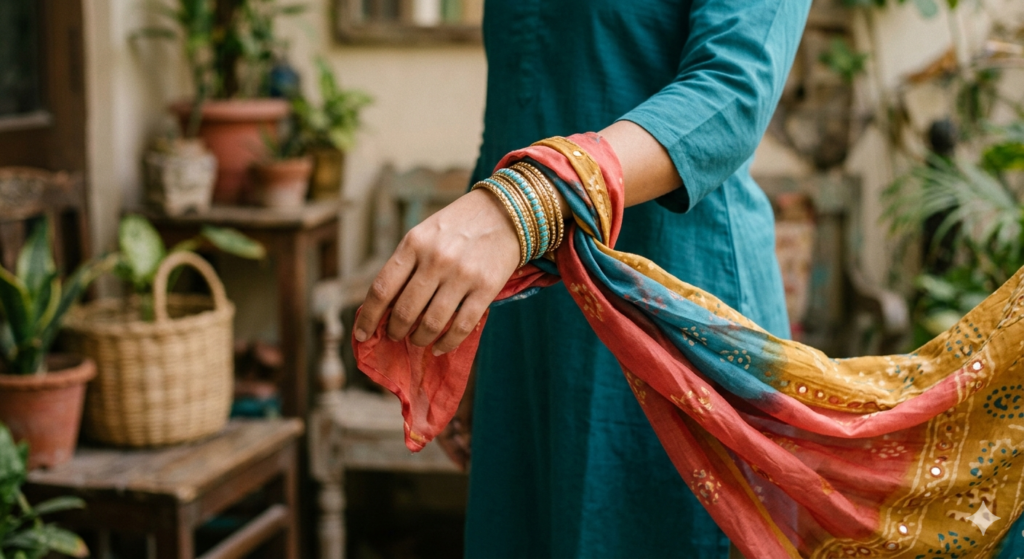
4. The Wrist Wrap: The Free Spirit
Commonly seen in college hallways and casual outings, this involves loosely wrapping one end of the dupatta around the wrist while the rest hangs casually or is thrown over the opposite shoulder.
The Personality Profile:
You are the adventurer. You find traditional rules a bit stifling and prefer a “bohemian” approach to life. Your dupatta is a tool—you might use it to wipe a smudge, shield yourself from a sudden breeze, or simply as something to fidget with while you think.
- Low Maintenance: You don’t want to spend twenty minutes with safety pins. You’d rather be out the door and on to your next project.
- High Energy: You’re likely the one suggesting a sudden road trip or a new restaurant.
- Adaptable: You handle change with ease, just as easily as you shift your dupatta from wrist to shoulder.
5. The “Guunghat” or Head Veil: The Spiritual Traditionalist
While less common in daily urban wear today, the head veil remains a staple in weddings, religious ceremonies, and rural heartlands.
The Personality Profile:
You are a guardian of heritage. Whether you wear it for religious reasons or as a stylistic nod to your roots, this choice reflects a deep respect for ancestry and sacred spaces.
- Introverted Strength: There is a sense of mystery and “sacred privacy” in this look. You value your inner world deeply.
- Duty-Bound: You are likely someone who takes your responsibilities to family and community very seriously.
- Respectful: You understand the weight of symbols and use them with intention.
6. The Pleated and Pinned (The Uniform Style): The Perfectionist
Every fold is measured. Every pleat is sharp. Multiple pins ensure that not a single thread moves out of place, even in a windstorm.
The Personality Profile:
You are the Architect of your own life. You love order, logic, and precision. If there is a “right” way to do something, you will find it and master it.
- Goal-Oriented: You don’t like distractions. A shifting dupatta is a distraction, so you eliminate the possibility.
- Sophisticated: There is a high level of “polish” in your appearance that commands immediate professional respect.
- Reliable: If you say you’ll be somewhere at 8:00 AM, you are there at 7:55 AM with a coffee in hand.
7. The Belted Drape: The Modern Power-Player
The dupatta is draped over one or both shoulders and then cinched at the waist with a belt (kamarband or leather belt). This creates a structured, almost “tunic-like” silhouette.
The Personality Profile:
You are a Disruptor. You take the traditional and give it a sharp, modern edge. You are likely a leader in your field or aspire to be one. You value “Fusion”—not just in clothes, but in ideas.
- Decisive: You like clear lines and defined shapes.
- Ambitious: This is a “power look.” It says you are ready for the boardroom and the ballroom.
- Strategic: You look for ways to make traditional silhouettes more functional for a fast-paced life.
8. The Around-the-Neck (The Scarf Style): The Pragmatist
The dupatta is simply looped around the neck, with both ends hanging down the back or front, much like a winter scarf.
The Personality Profile:
You are no-nonsense. You see the dupatta as a functional accessory rather than a ceremonial one. You are likely busy, active, and focused on the “here and now.”
- Youthful: This style has a sporty, youthful energy.
- Unpretentious: You don’t feel the need to “perform” femininity or status. You are comfortable in your skin.
- Direct: You say what you mean and mean what you say.
Understanding the Material: How Fabric Influences Personality Perception
The style of the drape is the “how,” but the fabric is the “what.” The two work together to create a personality “vibe.”
| Fabric | The “Vibe” | Personality Match |
| Chiffon/Georgette | Airy, flowing, playful. | The Social Butterfly. |
| Organza | Stiff, voluminous, dramatic. | The Creative Visionary. |
| Silk/Kanjeevaram | Heavy, regal, structured. | The Mature Leader. |
| Cotton/Khadi | Earthy, honest, grounded. | The Intellectual/Activist. |
| Phulkari/Bandhani | Vibrant, culturally loud. | The Life of the Party. |
The Psychology of Color in Your Drape
Beyond the drape, the color of your dupatta acts as a mood ring for the world to see.
- Red/Maroon: You are feeling passionate, traditional, or in a “celebration” mode.
- Sky Blue/Pastels: You are seeking calm, clarity, and approachability.
- Deep Greens/Blacks: You are leaning into your power, mystery, and sophistication.
- White/Ivory: You value purity, simplicity, and a “blank slate” approach to the day.
Conclusion: Wear Your Story
The beauty of the dupatta is that you don’t have to be just one “personality” forever. You might be the Perfectionist at a job interview on Monday, the Free Spirit at a weekend brunch, and the Maharani at your best friend’s wedding.
Fashion is one of the few places where we can “try on” different versions of ourselves. Your dupatta is the most versatile tool in that journey. So, the next time you pick up that length of fabric, ask yourself: Who am I today? And how do I want the world to see me?
Whether you pin it, belt it, or let it fly in the wind, make sure it feels like you. After all, the most beautiful thing you can wear is your own story, draped perfectly over your shoulders.
Pro-Tip for the Perfect Personality Match:
If you’re unsure which style to pick, look at your shoes!
- Heels? Go for the One-Shoulder Fall or Maharani style.
- Sneakers or Juttis? The Wrist Wrap or Around-the-Neck is your best bet.
- Boots? Try the Belted Drape for a fierce, modern look.